
About This Article
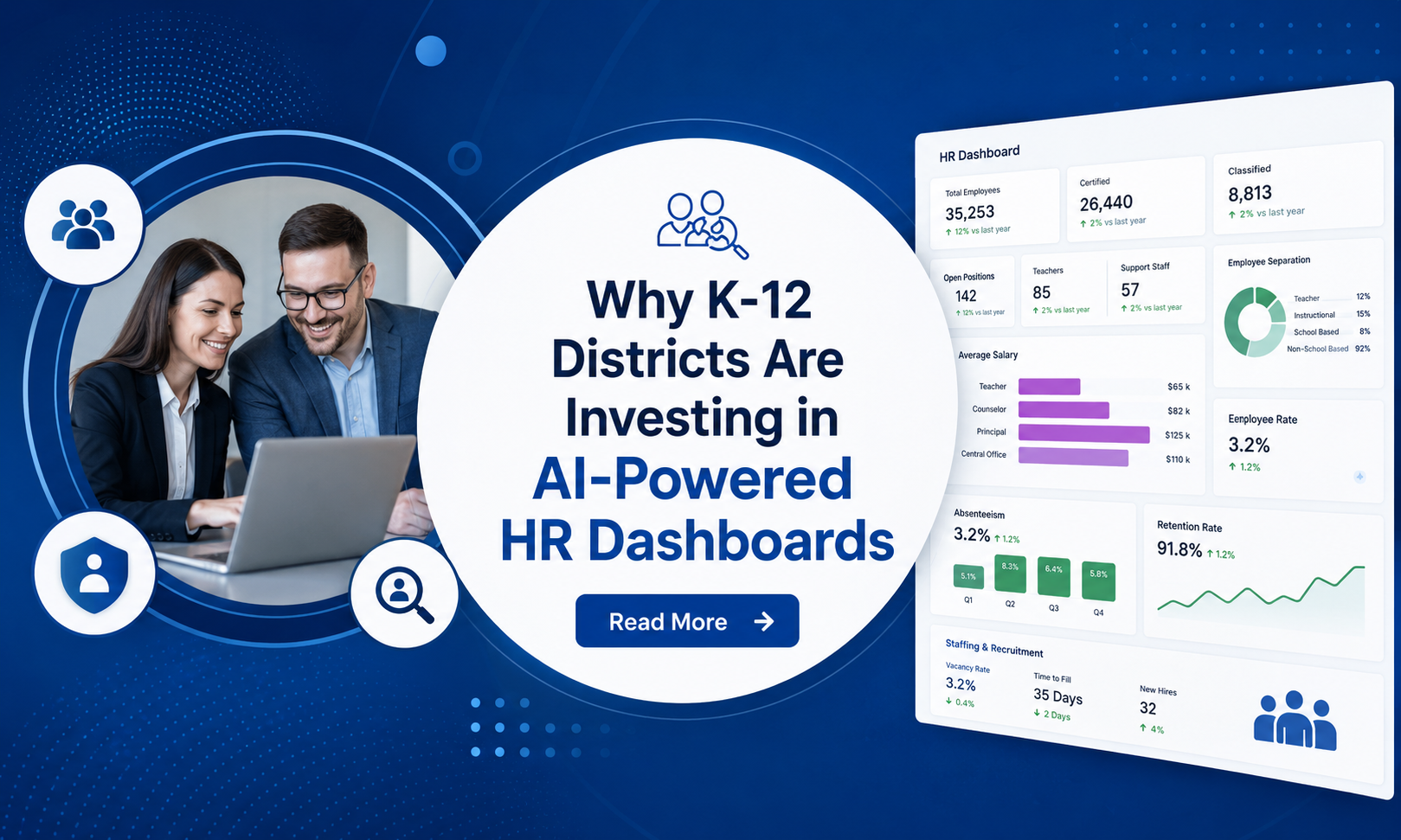
This article explores why K-12 districts are investing in AI-powered HR dashboards and how workforce analytics can improve hiring visibility, retention monitoring, and strategic workforce planning.
Executive Summary
K-12 districts are investing in AI-powered HR dashboards because workforce planning is becoming more complex and increasingly connected to district strategy. Modern dashboards help district leaders monitor hiring activity, identify staffing needs earlier, track retention patterns, and connect workforce decisions to broader organizational goals. With real-time visibility into workforce data, districts can make more informed decisions throughout the hiring cycle.
Summer in a school district carries a particular kind of momentum. Classrooms go quiet, but HR offices hum with activity. Posting cycles open, interviews fill calendars, and leadership teams revisit workforce plans before August arrives. For superintendents, CHROs, and district technology officers, this season is far more than an administrative routine. It is a genuine window of opportunity to shape the people’s side of the district’s strategic future.
In 2026, that window carries fresh significance. Workforce dynamics across K-12 are shifting in ways that reward deliberate, data-informed recruiting over the reactive patterns of prior years. Understanding the workforce challenges shaping this landscape is often the first step.
What Staffing Challenges Are Districts Facing?
The broad story on K-12 staffing has evolved. While teacher shortages have eased in many subject areas, districts are still navigating workload strain, hard-to-fill roles, and uneven funding, all of which continue to shape daily operations.
That nuance matters deeply for HR planning. A district might feel well-staffed on paper while quietly carrying vacancies in special education, secondary math, or English learner instruction.
When that level of turnover pairs with a shrinking pipeline of incoming educators, the staffing picture becomes less about volume and more about precision.
This means the hiring work for summer 2026 requires more sophistication from district HR teams. Knowing exactly which roles carry risk, which schools have the greatest need, and which candidate segments are most responsive requires a level of data quality that spreadsheets and annual surveys alone cannot provide.
Why Is Recruitment Becoming a Year-Round Priority?
One of the most meaningful shifts in K-12 HR right now is reframing recruitment from a once-a-year administrative task to a continuous, strategically guided function.
This reframing shows up in how districts are thinking about their employer identity. Qualified candidates today research a district’s culture, leadership, and values well before submitting an application.
The way a district communicates its mission externally through its website, job postings, and responsiveness to applicants sends signals that either attract or discourage high-quality candidates.
It also shows up in the hiring timeline itself.
Key recruiting priorities include:
- Posting positions earlier
- Streamlining the application experience
- Reducing the time between the interview and the offer
- Maintaining candidate engagement throughout the hiring process
- Building year-round talent pipelines
Summer is the season to act on that knowledge.
The findings point toward a field in motion, one where districts willing to modernize their approach are seeing measurable gains.
What Makes a Strong Recruitment Strategy?
Districts building durable and responsive recruiting operations share several common characteristics.
The table below outlines key dimensions of a modern K-12 recruiting framework.
| Recruiting Dimension | What It Looks Like in Practice |
|---|---|
| Role Level Workforce Visibility | Leaders can see vacancy rates, projected openings, and retention risk by school, grade level, and role type. |
| Candidate Pipeline Tracking | HR teams maintain active pools of vetted candidates across high-need areas year round. |
| Time to Fill Monitoring | Dashboards surface how long each open role has been active and flag positions approaching critical delays. |
| Onboarding Completion Data | New hire progress through credentialing, orientation, and assignment steps is tracked in real time. |
| Retention Signal Tracking | Exit interview themes, staff survey trends, and departure patterns are reviewed regularly. |
| Equity in Hiring Process | Application and selection data are reviewed across demographic dimensions. |
When these dimensions are visible in a single integrated view, the recruiting season becomes far more manageable and purposeful.
What Are District Leaders Looking for in HR Analytics Solutions?
During StrategicPlan360 conversations with district leaders, a common theme continues to emerge. Districts often have access to significant amounts of information but need a more effective way to translate it into action.
One district leader recently shared:
“We are interested in seeing how Strategicplan360 can turn our strategic goals into a clear, real-time dashboard. We currently collect a vast amount of data and are looking to transform these pockets of information into accessible, actionable insights.
We are especially interested in a solution that connects student outcomes, performance, and operations in one place to support more informed, data-driven decision making.
This reflects a broader shift occurring across K-12 leadership. Districts are increasingly focused on integrating workforce, operational, and strategic data to support faster, more confident decision-making.
How Do HR Dashboards Support Workforce Planning?
Recruiting decisions made without reliable data carry predictable costs, including slower hiring timelines, staffing gaps, and missed opportunities to align talent with district priorities.
HR dashboards designed for K-12 provide something fundamentally different. Rather than compiling reports after decisions have already been made, they surface information when leaders need it most.
Benefits include:
- Earlier identification of staffing risks
- Better visibility into hiring pipelines
- Improved retention monitoring
- Faster workforce reporting
- Stronger alignment between staffing and strategic goals
Staffing goals move from aspirational statements in a planning document to measurable commitments supported by ongoing monitoring.
When HR data connects directly to strategic priorities, the district’s people strategy and academic strategy begin to work together.
How Can Districts Strengthen Workforce Strategy?
The best outcome of a well-managed hiring season is not simply a fully staffed district roster.
It is a workforce positioned to deliver on the district’s commitments, with the right people in the right roles, supported from day one, and equipped for long-term success.
That outcome requires planning that extends beyond job postings and interview panels.
District leaders can strengthen workforce strategy by:
- Monitoring workforce trends continuously
- Tracking retention signals proactively
- Aligning staffing goals with strategic priorities
- Using real-time workforce analytics
- Connecting operational and workforce planning efforts
Districts making these connections are finding that each hiring season becomes more intentional and less reactive than the one before.
A District Perspective on Data Visibility
The value of integrated analytics extends beyond workforce planning alone.
As one district leader noted:
“Having all this workforce data at our fingertips is a game-changer. Previously, we had to dig through multiple reports across different locations, making it difficult to understand staffing needs and make timely decisions. Now, the data is centralized, visual, and actionable. “
Executive Director of Strategy and Innovation – Kentwood Public Schools (MI)
Frequently Asked Questions
What is an AI-powered HR dashboard for K-12 districts?
An AI-powered HR dashboard provides district leaders with centralized visibility into hiring activity, workforce trends, retention signals, staffing patterns, and operational metrics.
Why are school districts investing in workforce analytics?
Workforce analytics helps districts improve hiring decisions, identify staffing challenges earlier, and align workforce planning with district priorities.
What workforce metrics should district leaders monitor?
Common metrics include vacancy rates, time to fill, onboarding progress, retention trends, recruitment pipeline activity, and staffing distribution.
How can HR dashboards support strategic planning?
HR dashboards connect workforce information with district goals, helping leaders monitor progress and support accountability.
What are the benefits of real-time workforce visibility?
Real-time visibility helps districts identify trends sooner, allocate resources more effectively, and make more informed decisions throughout the year.