
About This Article
Building and retaining a strong educator workforce has become one of the most important priorities for K–12 districts. As workforce challenges become more complex, district leaders are increasingly looking beyond traditional HR reporting to gain deeper visibility into staffing trends, retention, and long-term workforce planning.
Quick Summary
AI-powered HR dashboards help districts transform fragmented workforce data into meaningful intelligence that supports better decision-making. This article explores how connected HR analytics can improve recruitment, strengthen teacher retention, monitor staffing trends, and help district leaders make more informed workforce decisions through real-time visibility and predictive insights.
The Evolving Role of Workforce Intelligence in K–12
In the modern educational landscape, the strength of a school district is measured by the quality and stability of its educators.
As we navigate 2026, the transition from administrative oversight to strategic talent management has become the hallmark of high-performing districts.
For Superintendents, CTOs, and HR leaders, the objective is clear: move beyond reactive staffing and toward a proactive, data-informed culture that prioritizes both operational efficiency and educator well-being.
The shift is driven by a fundamental change in how workforce data is viewed. It is no longer a collection of static figures stored in disparate systems; it is the pulse of the district.
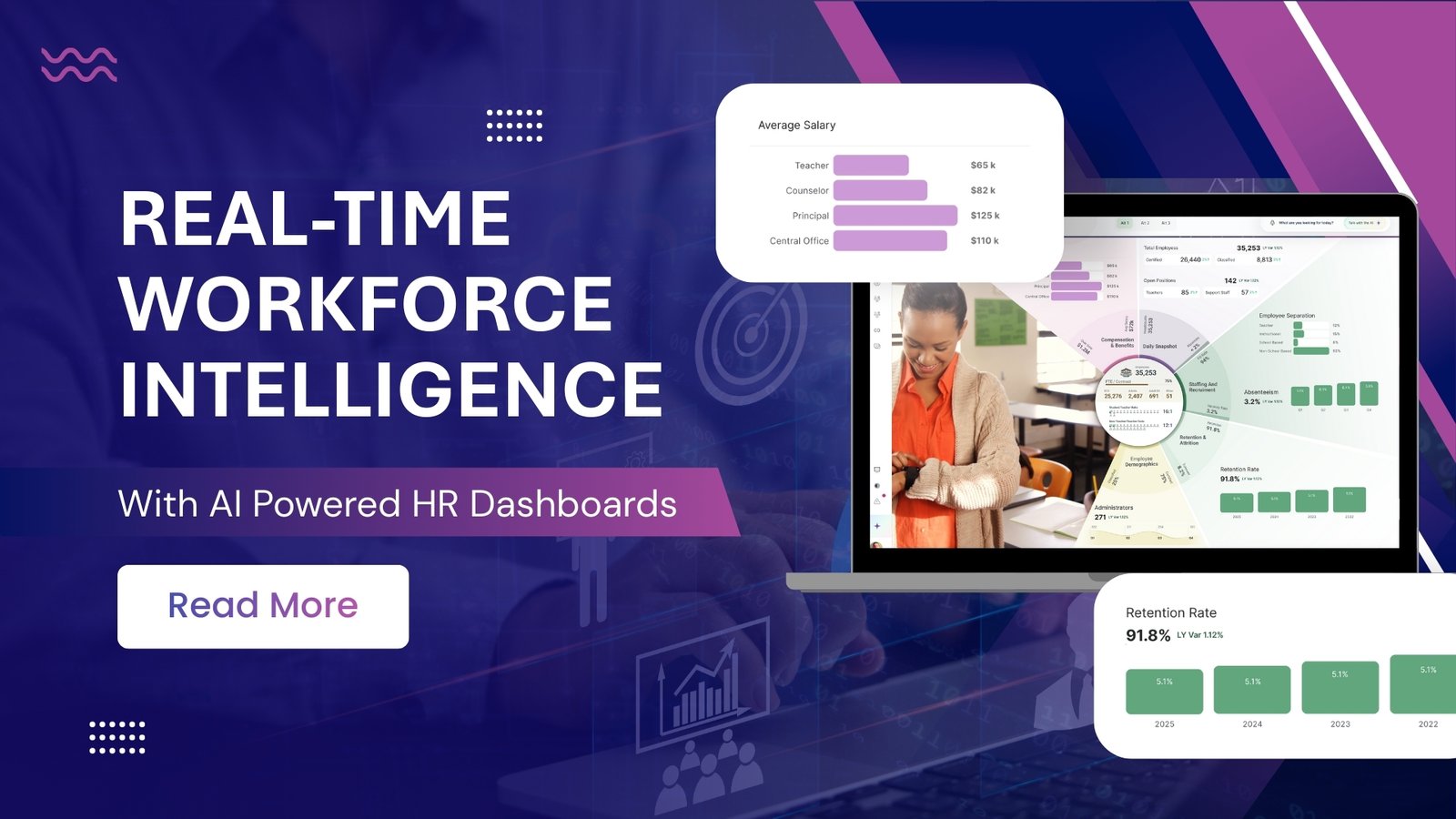
By leveraging AI-powered HR Dashboards, K-12 leaders are transforming fragmented data points into a unified strategic layer, enabling faster decisions and more equitable outcomes.
The Executive Advantage: From Data Gaps to Strategic Clarity
By leveraging AI-powered HR Dashboards, K-12 leaders are transforming fragmented data points into a unified strategic layer, enabling faster decisions and more equitable outcomes.
An enterprise-level AI-powered HR Dashboard bridges this gap by providing:
Unified Visibility – Integrates HRIS, Payroll, and Student Information Systems (SIS) into a single pane of glass.
Real-Time Accuracy – Daily updates replace manual spreadsheets, ensuring leadership always works with current information.
Predictive Insights – Moves beyond understanding what happened to identifying what is likely to happen, enabling earlier intervention before vacancies affect classrooms.
Protecting the Bottom Line: The ROI of Retention
The financial implications of workforce instability are significant.
Whether it is a spike in mid-year departures at a specific campus or a trend among early-career educators, a data-driven approach allows for targeted support. This not only preserves the district budget but, more importantly, protects student achievement.
Operational Excellence Through Integrated Analytics
For the CTO and CIO, the challenge often lies in the “data silo.”
Information regarding staffing costs lives in Finance, certification data lives in HR, and classroom impact lives in the Student Information System (SIS).
A modern AI-powered HR Dashboard acts as an intelligent connector across these systems.
Optimizing the Hiring Pipeline
Monitor recruitment progress across every department.
By identifying bottlenecks in the time-to-hire cycle, districts can streamline compliance with state reporting guidelines and help ensure high-quality candidates are not lost to faster-moving competitors.
Advancing Equity and Representation
True equity requires visibility.
Aligning the workforce to reflect the diversity of the student body becomes a measurable objective rather than an abstract ideal.
Real-Time Staffing Cost Insights
Gain immediate clarity on workforce spending and salary bands.
For districts implementing complex incentives such as the Teacher Incentive Allotment (TIA), real-time tracking supports transparency and alignment between HR strategy and financial accountability.
Why K–12 Leaders Are Pivoting to AI Intelligence
The most successful districts in 2026 are those that empower their leaders with the right information at the right time.
Real-time workforce intelligence helps leadership teams respond more quickly, strengthen workforce planning, and make informed decisions supported by connected data.
| Strategic Goal | The Dashboard Impact |
|---|---|
| Operational Speed | Respond to board inquiries and leadership questions in minutes, not days. |
| Retention Strategy | Use predictive analytics to mitigate turnover with 75–85% accuracy. |
| Equity & Compliance | Automatically generate leadership-ready reports for TEA and state submissions. |
| Resource Allocation | Align staffing costs with budget goals through daily workforce snapshots. |
Leading the Future of Education
The AI-powered HR Dashboard is not a replacement for your existing systems; it is the intelligence that helps those systems work together more effectively.
It empowers district leaders to move from managing staffing challenges to making more proactive, data-informed workforce decisions.
When workforce data is clear, actionable, and updated in real time, the path toward a more stable, resilient, and effective workforce becomes easier to navigate.
FAQs
Does StrategicPlan360 replace our existing HRIS or Payroll systems?
No. StrategicPlan360 serves as a strategic analytics layer that integrates with your existing HRIS, Payroll, and other district systems, bringing workforce information together into a unified view for district leadership.
How often is workforce data updated?
The dashboard provides daily workforce data updates, reducing reliance on manual spreadsheets and helping district leaders work with current information when making staffing decisions.
Who can use the AI-powered HR Dashboard?
The dashboard is designed for Superintendents, CTOs, HR Directors, and other district leaders. Role-based access also allows principals and authorized staff to view campus-specific workforce insights where appropriate.
Can the dashboard support large school districts?
Yes. The platform is designed to support districts of varying sizes and can scale to meet the workforce planning needs of organizations managing hundreds or thousands of employees.
How does the dashboard support compliance and state reporting?
By integrating workforce data across district systems, the dashboard helps leadership teams generate reporting that supports state requirements and internal decision-making while reducing manual effort.