
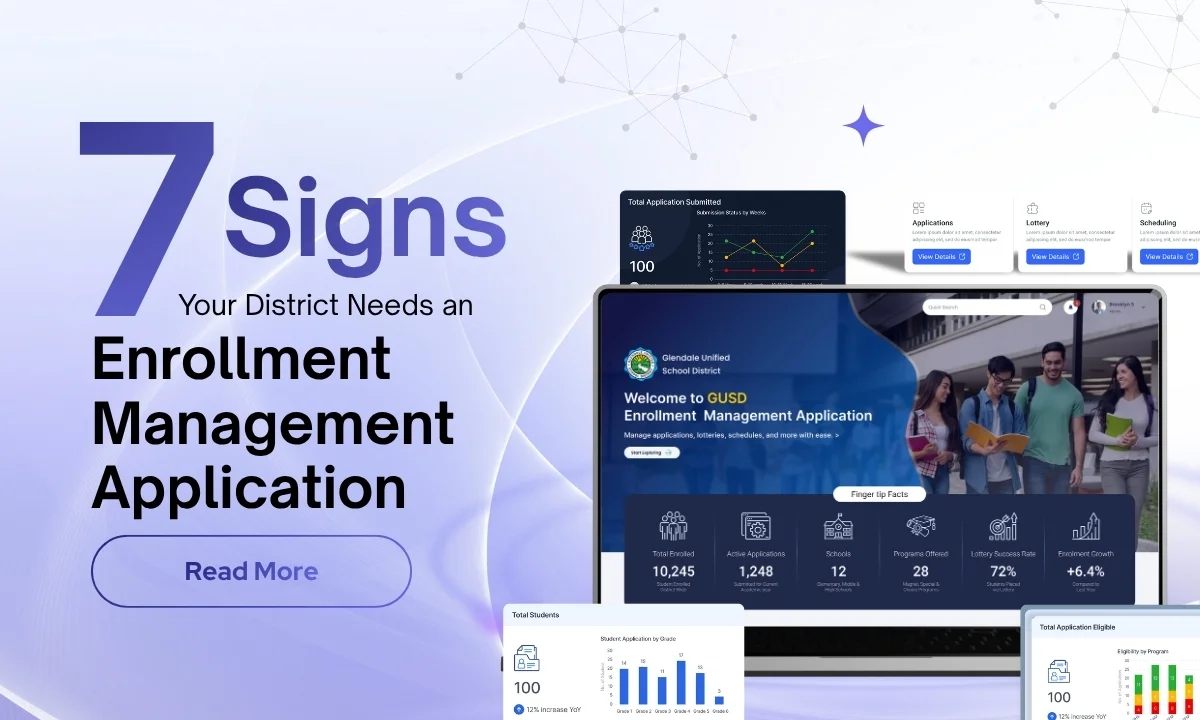
About This Article
Enrollment patterns are shifting in many K–12 districts. Demographic changes, growing school choice, and evolving family preferences present new planning challenges for district leaders. This article outlines seven signs a district has outgrown traditional enrollment management processes and might benefit from a more strategic approach to enrollment planning and forecasting.
At a Glance
A Student Information System (SIS) manages currently enrolled students. An Enrollment Management Application (EMA) helps leaders track trends, forecast demand, and detect issues before they impact staffing, budgets, programs, and facilities. If enrollment discussions are becoming harder, it may be time to assess whether existing systems provide leaders with enough visibility.
Public school enrollment continues to evolve in ways that affect nearly every aspect of district operations. Enrollment influences staffing decisions, budgeting, program planning, facility utilization, and long-term strategic priorities.
Most districts have ample enrollment data. The main challenge is consolidating that information to support timely planning and decisions. As patterns grow more dynamic, leaders seek tools to move beyond reporting the past and begin forecasting the future.
The following signs are becoming increasingly common in districts across the country.
Sign 1: Earlier Visibility Creates More Planning Options
There is a meaningful difference between knowing enrollment changed and knowing it early enough to respond.
In many districts, the clearest picture of enrollment shifts does not emerge until reporting cycles are complete and budgets, staffing assignments, and schedules have already been finalized. By that point, opportunities for adjustment may be limited.
Because funding often depends on student enrollment, even small changes can impact staffing, programming, and resource allocation. Earlier visibility helps leaders spot shifts and consider responses before effects escalate.
An Enrollment Management Application provides real-time dashboards by school, grade level, and program. Instead of discovering trends months later, leaders can monitor enrollment activity as it develops and make adjustments when additional planning options are still available.
Sign 2: Understanding Family Enrollment Decisions Matters More Than Ever
Families today have more educational choices than ever before. Charter schools, private schools, homeschooling options, and specialized programs are influencing enrollment decisions in many communities.
The challenge for many districts is not simply knowing that enrollment is changing. It is understanding why those changes are occurring and whether patterns are emerging across specific schools, grade levels, or neighborhoods.
An Enrollment Management Application can bring together withdrawal trends, exit survey information, and demographic data to help districts better understand enrollment movement and support more informed family engagement strategies.
Sign 3: Why Unified Enrollment Data Matters More Than Ever
Enrollment data often resides in many systems—student information, transportation, special education, state reporting, and early learning platforms each hold parts of the picture.
Staff often spend substantial time collecting and cross-checking data before it informs planning.
Efficiency isn’t the only concern. Scattered data can cause inconsistencies, slow reporting, and leave leaders working with outdated information.
Sign 4: Planning for Next Year Begins Earlier Than Ever
Enrollment planning and staffing planning are closely connected.
District leaders often make staffing decisions months before the start of the school year. Those decisions become more difficult when future enrollment projections rely primarily on historical counts rather than emerging trends.
An Enrollment Management Application helps districts build projections using multiple inputs, including historical enrollment patterns, demographic trends, residential development activity, and competitive enrollment factors. This provides leaders with additional context as they prepare staffing and budget plans.
Sign 5: Why Real-Time Enrollment Visibility Matters
Enrollment conversations are increasingly becoming part of regular board discussions.
District leaders are often asked questions about enrollment trends, grade-level changes, school utilization, future projections, and budget implications. These are important conversations that help shape long-term planning decisions.
When enrollment information requires extensive manual preparation, leaders may spend valuable time assembling reports rather than discussing potential responses.
When enrollment information requires extensive manual preparation, leaders may spend valuable time assembling reports rather than discussing potential responses.
An Enrollment Management Application provides real-time reporting, trend analysis, and scenario planning tools that help leaders prepare for these conversations with greater visibility into current conditions.
Sign 6: The Kindergarten Pipeline Starts Earlier Than Many Realize
The students entering kindergarten next year are already part of the story today.
Many families are currently participating in early childhood programs, community childcare services, Head Start, and pre-K programs. Their experiences and decisions often influence future enrollment patterns.
Sign 7: Major Decisions Benefit from Current Enrollment Information
Few district decisions carry greater long-term impact than facility planning, attendance boundary reviews, or school consolidation discussions.
These conversations affect students, families, staff, and communities. They also rely heavily on enrollment information and future projections.
An Enrollment Management Application supports these discussions with building-level projections, geographic demand analysis, utilization modeling, and enrollment forecasting tools, providing a more complete planning picture.
At a Glance: The 7 Signs and What They Signal
| The Sign | What It May Mean | How an EMA Helps |
|---|---|---|
| Enrollment changes are identified late | Limited time to respond | Real-time dashboards and alerts |
| Family enrollment decisions are difficult to track | Emerging trends may be harder to identify | Enrollment movement and trend analysis |
| Data exists across multiple systems | Increased reporting complexity | Unified enrollment data view |
| Staffing decisions rely on limited forecasting | Planning uncertainty | Predictive enrollment models |
| Board conversations require manual reporting | Slower access to information | Real-time reporting and scenario planning |
| Limited visibility into future kindergarten cohorts | Reduced planning horizon | Early pipeline tracking |
| Major decisions rely on historical data | Reduced visibility into future conditions | Current forecasting and utilization modeling |
FAQs
What is the difference between a Student Information System and an Enrollment Management Application?
A Student Information System manages information for currently enrolled students. An Enrollment Management Application focuses on enrollment planning, forecasting, trend analysis, and family engagement to help districts prepare for future enrollment conditions.
How does enrollment affect district budgeting?
Many funding formulas are tied to student enrollment. Changes in enrollment can influence staffing, program funding, facility utilization, and long-term financial planning.
What are common early indicators of enrollment change?
Examples include changes in withdrawal activity, kindergarten registration patterns, school choice participation, attendance zone trends, and demographic shifts within the community.
How can enrollment forecasting support staffing decisions?
Forecasting helps district leaders estimate future student counts by school and grade level, providing additional information for staffing, scheduling, and budget planning.
Why is early childhood enrollment data important?
Early childhood participation and demographic trends can provide insight into future kindergarten cohorts, helping districts better understand enrollment patterns before formal registration begins.